An outdoor elevator connects exterior levels without taking space from your rooms. At a lake house, this means easily moving from a lower patio to the main floor or an upper deck. Cibes Symmetry’s Cibes Outdoor Lift provides up to 23 feet of vertical travel and offers four landing options.
Quick answer
An exterior lift can connect different levels of a lake home while preserving indoor space. When choosing an exterior elevator for your lake home, start with the vertical rise, boarding areas, expected weather exposure, and frequency of use. Because an elevator car travels up and down, hillside access requires a separate assessment.
What is an outdoor elevator?
An outdoor elevator is a lift designed for the exterior of a home, with an enclosure and components suited to the specified outdoor conditions. Homeowners may also call it an exterior elevator, outside elevator, or outdoor home elevator.
Some systems include a prefabricated enclosure, so you don’t need to build a shaft inside the house. But a self-supporting enclosure still needs an approved foundation, anchorage, and a transition from the landing to the inside of the home. Any existing deck will still need supporting construction.
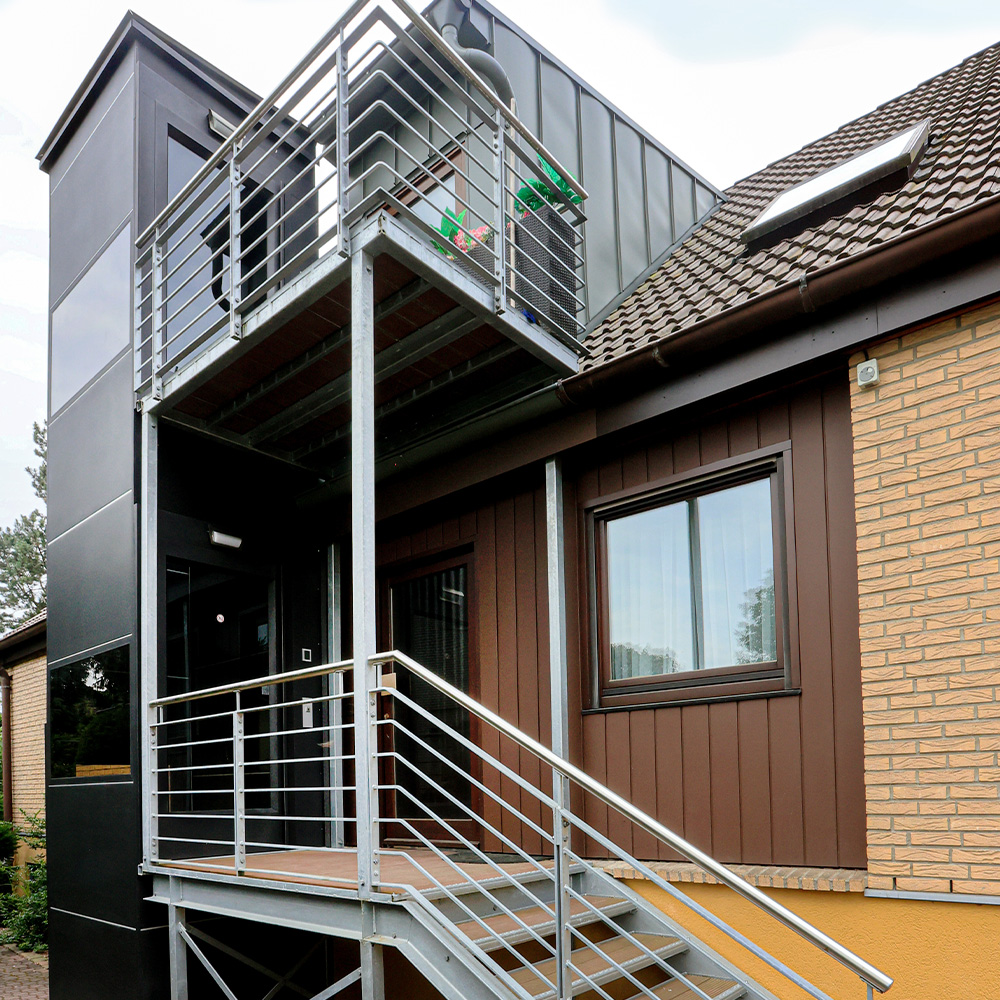
Outdoor lift with deck access, residential installation
Also consider the equipment classification. Cibes Symmetry lists the Cibes Outdoor Lift as one of its
vertical platform lifts. Your proposal should identify the exact product needed and any applicable installation requirements. Just using the word “elevator” isn’t specific enough and may lead you astray.
Our home elevator installation team can help you compare an exterior location with the available indoor options.
Can you install an elevator on the outside of a house?
Yes, you can. You can build an exterior elevator if the property provides suitable support, power, access, and approved connections to the building. The original assessment should account for each anticipated step of the process.
Foundation and support
Confirm the pad, ground conditions, drainage, and fixing details before construction.
Landing connections
Plan doorways, boarding space, guards, and the connection to each floor or deck.
Electrical preparation
Identify the supply route and the requirements for the selected equipment and options.
Approach and service access
Leave room for boarding, mobility devices, routine maintenance, and equipment delivery.
A lift beside the garage may create an ample path from the parked car to the house. A lift on the lake side may serve a patio and deck. Those locations solve different problems, so begin with the route you use most often, and expand the project as needed.
Where do outdoor elevators work on lake and hillside properties?
Outdoor elevators are most effective on properties where the vertically aligned landings connect useful parts of the property. For example, we installed these outdoor elevators in front of Lanier, Keowee, and Hartwell lakes, and the question was how the paths between the driveway, living floor, deck, and waterfront relate to one another.
House to dock or dock walk
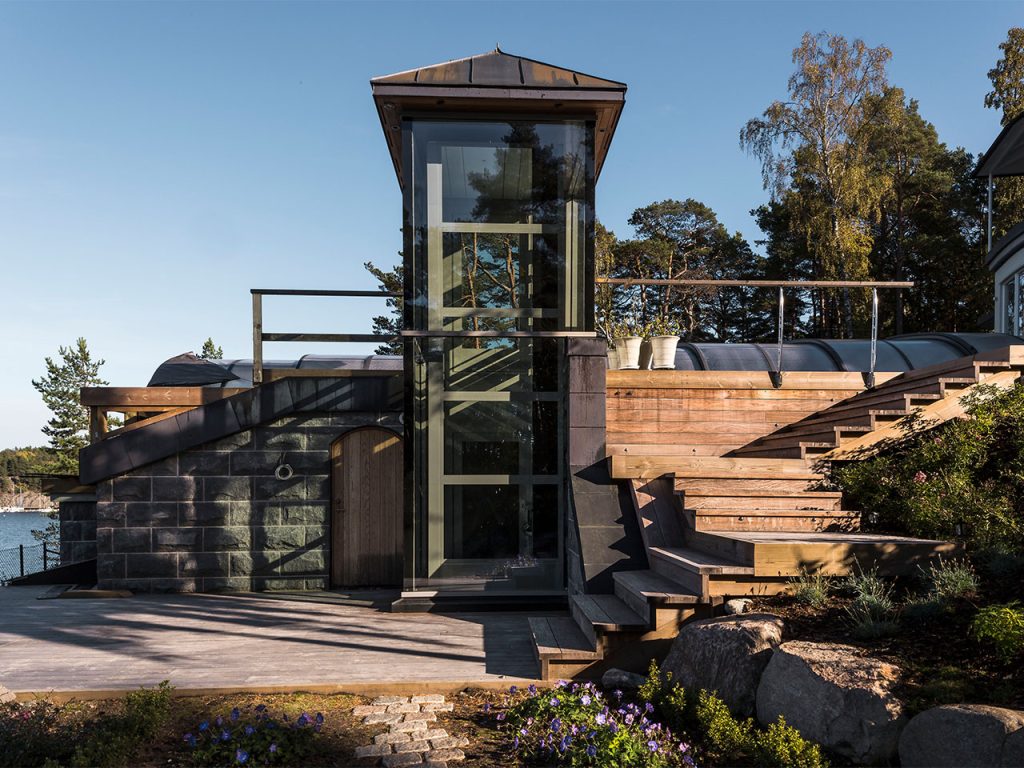
A vertical lift may connect the house or deck to a lower landing that provides access to the dock – but that’s it. This does not provide an accessible route from the upper portion of the slope to the water. A long,
inclined route would require entirely different equipment and a completely different site plan.
If there are stairs immediately after exiting the lift, then using the lift does not address
wheelchair accessibility issues. This raises a new set of accessibility questions.
Plan the waterfront connection separately
Unless special accommodations are made, a residential outdoor lift will not necessarily attach to a floating dock or operate within a flood zone. If this is your goal, first confirm all needs, including the elevator landing location and shoreline permissions, and consult the manufacturer before selecting equipment.
Ground level to an upper deck or main floor
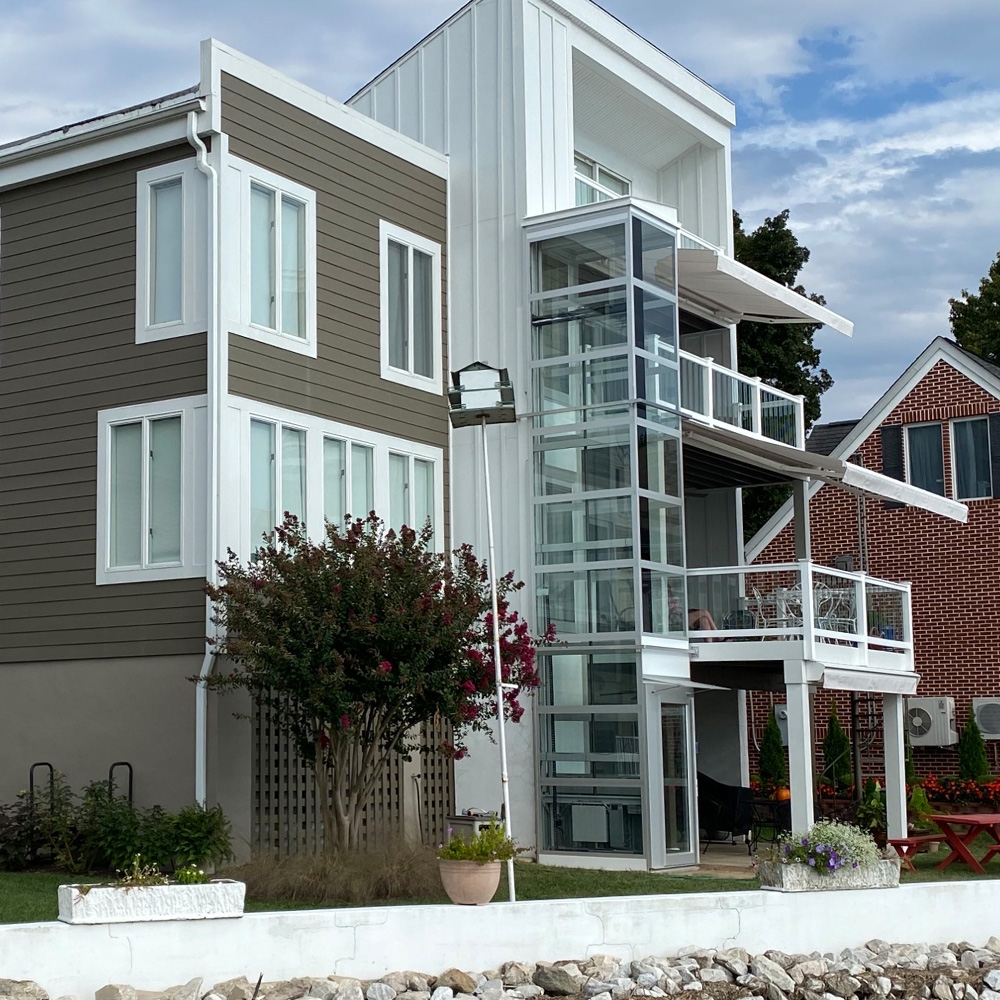
A raised deck or main-floor entrance can be a practical choice when parked cars or lower patio areas are below it. If there are other important functional areas of the home comprising several stops beneath, then it is important that there is sufficient area to board the lift at every level.
Also consider how people enter your home after leaving the elevator platform. Assess all potential obstacles, such as door thresholds, drainage channels, and narrow deck passageways, before making major decisions during planning and layout evaluation.
Preserve Indoor Space with an Exterior Installation

An outdoor, or exterior, installation may let you keep all closet space and living room intact, since changing your home’s internal layout for an inside passageway can trigger a cascade of new accommodations. An exterior elevator installation may be less expensive than building an indoor passageway.
However, before you decide, compare both strategies.
What does an outdoor elevator need in Georgia and Carolina weather?
An outdoor elevator must match the expected temperatures, rainfall, and inclement weather exposure at its location. The same model may need different additions if positioned beside a shaded wall, rather than on a sunny deck.
Heat and humidity
Cibes Symmetry’s outdoor elevator products have an operating range of
14°F to 86°F for outdoor lifts, with “AC-ready” and heating options available for units that need to withstand exposure outside that range. This is an important factor when considering an installation in
Georgia or either of the Carolinas.
Ask how the desired outdoor elevator model can handle expected summer conditions. An “AC-ready” exterior elevator means the model includes the necessary preparation for cooling. It does not establish that air conditioning is included or installed automatically.
The manufacturer should identify the temperature-control equipment, its power requirements, and any weather-related limitations. Review how the unit handles solar exposure and ventilation before final approval.
Storms and heavy rain
To handle storms, the manufacturer lists a sloped roof, sealed call buttons, protected electrical equipment, and door-canopy options as available features. Steel canopies for exterior elevators are offered for heavier rain and snow.
Those features do not replace the need for proper drainage around your design. Account for roof runoff, downspouts, and surface water around the installation. Find out where water will go during heavy rain, especially if the lift sits at the bottom of a slope.
Protection around an electrical compartment is necessary, but not sufficient to call the elevator “flood-proof.” You should still conduct a separate review for flood exposure, especially if the exterior elevator sits near a rising and falling waterline.
Near the water
For its exterior elevators, Cibes specifies aluminum doors and an anti-corrosive base frame. A waterfront project still needs an exposure-specific maintenance and material review.
Another factor to be considered is salt-air exposure. Salt spray can be carried up to 50 miles inland. If this is a concern based on your geography, confirm which finishes are ideal for potential salt exposure and what the warranty covers.
Cibes Outdoor Lift: planning specifications
| Specification |
Published figure |
| Maximum travel |
23 feet |
| Maximum stops |
4 |
| Rated load |
880 pounds |
| Speed |
30 feet per minute |
| Power supply |
230 VAC, 60 Hz, 16 AMP, single phase |
Source: Cibes Symmetry’s Cibes Outdoor Lift specifications. Published limits do not establish approval for every property or configuration.
How much does an outdoor elevator cost?
An outdoor elevator quote should be specific to your project, including the equipment, weather options, and installation/construction.
Other factors that can affect the scope of the project, in turn affecting the quote, are the amount of foundation work necessary, distance from the electrical components to the home grid, ease of access to the site, and the viability of connections to the existing infrastructure.
Ask for these items in your quote
- Equipment: Model, travel, stops, doors, and enclosure.
- Weather options: Cooling, heating, canopies, and specified finishes.
- Site work: Foundation, drainage, grading, and electrical preparation.
- Landing connections: Deck changes, doorways, guards, and finish repairs.
- Project completion: Delivery, installation, approvals, testing, and handover.
A clear scope that specifically identifies each line-item and its associated cost is ideal. Choosing a low-starting figure without knowing exactly where costs are allocated is how scope creep, disputes, and tasks left undone can turn an exterior elevator project into a nightmare.
Get a price for your outdoor elevator
Tell us how many levels you need to connect and where the lift would go. We’ll tell you which outdoor lift fits and give you an installed price.
Get an outdoor elevator quote
Should you choose an outdoor elevator, porch lift, or outdoor stair lift?
Choose the best option according to the location of the route, the needs of the rider, and what objects need to be transported. A porch lift is usually the solution for a raised entrance. A
stair lift follows stairs and requires a seated transfer, only solving transportation needs for a flight of stairs. An enclosed outdoor lift may suit a more extensive vertical connection.
Some solutions solve the same problem: an enclosed outdoor lift and an open porch lift can both be vertical platform lifts. Compare actual models to your situation rather than treating them as distinct and separate product categories.
| Consideration |
Cibes Outdoor Lift |
Open porch lift |
Outdoor stair lift |
| Travel |
Up to 23 feet vertically |
Model-specific vertical rise |
Along the approved stair route |
| Wheelchair use |
Check platform fit and boarding space |
Check platform fit and boarding space |
Requires transfer to the seat |
| Riders |
Within rated load and approved configuration |
Model-specific occupant allowance |
One seated rider |
| Space |
Enclosure, foundation, and landings |
Platform, foundation, and gates |
Stair rail and boarding areas |
| Cost comparison |
Include enclosure and climate equipment |
Compare a quote for the required rise |
Compare straight or custom rail pricing |
What permits and service does an outdoor elevator need?
Approval requirements for installing a home elevator depend on the state, local authority, equipment classification, and property use. Not all outdoor elevator projects are handled by the same agency or agencies.
- Georgia: Rules governing private elevators include installation permit provisions for private residence elevators. Confirm what permit will be necessary for your selected lift, along with local building and electrical requirements.
- South Carolina: South Carolina does not have an agency that inspects elevators in private residences. Confirm applicable local permits and whether the proposed use falls within that exemption.
- North Carolina: The Elevator Safety Act excludes elevators located and operated in a single-family residence. Verify how the exterior installation will be classified before moving forward.
Start with the official guidance from Georgia, South Carolina LLR, and North Carolina. Each situation will require a closer look at specific regulations. For example, if your elevator has shared access, is on a rental property, or is on a waterfront, different rules may apply.
For Contractors: before handover, obtain the operating instructions, service schedule, and the contact information for the party responsible for repairs. Find out about what protocols exist following flooding or storm damage. If you witness unusual movement, noise, door jamming, or water intrusion, report it before returning the equipment to normal use.
Frequently asked questions
Can an outdoor elevator match the exterior of my home?
It can! Inquire about the selected model’s enclosure finishes, glazing, and door color options. Not all cosmetic choices are compatible with available outdoor elevator models, but there are a wide variety of choices that are often compatible with modern property designs.
Can you restrict access when the lake house is empty?
Absolutely. Remote access methods are different for every model, so ask what security features are available for the model of your choice. Each system will need some form of approved or remote access for authorized guests and service technicians. Security protocols cannot interfere with elevator emergency functions.
What should you check in an outdoor elevator warranty?
With an outdoor elevator warranty, review coverage for parts and installation labor separately. Find out how the warranty addresses wear from weather exposure, corrosion, and any additional cooling equipment. It’s also important to determine what maintenance obligations exist for your elevator model of choice and whether service visits include travel to your property for repair.